- Green Mountain Remains A Short Candidate - Seeking Alpha http://bit.ly/Vi2C70
- The Restaurant Performance Index Is Flashing Warning Signals - Seeking Alpha http://bit.ly/Vi2Ef2
- The Austerity Dictionary | The Big Picture http://bit.ly/Vi5IaQ
- Florida Debt Shrinking Most in Decades Fuels Rally: Muni Credit - Bloomberg http://bit.ly/YKRohK
- Finding your niche | Attitrade-Proactive Trading http://bit.ly/Vi6ftt
- Bespoke Investment Group - Think BIG - Ford F-Series Sales In November Highest Since 2005 http://bit.ly/YKS1aY
- Things about social media: EVERYBODY KNOWS . . . | The Big Picture http://bit.ly/Vj6Efe
- Global Gas Push Stalls - WSJ.com http://j.mp/UeAMqQ (via Instapaper)
- Lunch with Warren Buffett : The New Yorker http://bit.ly/YGBaG9
- New gold standard not practical | gold, standard, money - Opinion - The Orange County Register http://bit.ly/YOdv6M
- History Shows Why Germany Should Help Greece - Bloomberg http://bit.ly/YOdwHW
- Is Spying on Corporate Jets Insider Trading? http://bit.ly/Sw4EBH
- The Science Behind Gifting (and Regifting) http://bit.ly/YKSf1Z
- To Regift or Not to Regift, That Is the Question | Psychology Today http://bit.ly/YOdvE1

Open Strategist
Wednesday, December 5, 2012
Wednesday Links

Tuesday, December 4, 2012
Buffet on philantrophy
There's a video interview with Buffet from Forbes on philanthropy posted on YouTube. I jotted down some notes to share since the Oracle's philosophy is usually worth remembering:
Watch the video here:
On his kids:
·
“My kids went to public schools, and their kids
went to public school and that's how it will be. I told them a long time ago
that I'm not going to let you control my money. If you're not happy at 0.1%
then you'll never be happy with more money. They know everything in my will; the
fact that they know they will receive a significant amount of my wealth. They know
that they have a responsibility towards it”
On why he outsources philanthropy?
·
“I don’t do a lot of philanthropic work. Why Bill
and Melinda Gates foundation? Why outsource?
Well when my wife had a baby, I didn't deliver it[laughs]. Smith said that specialization is a good thing and it helps society. My wife is good with un-piling the money, and I'm good with piling it. When she died earlier, I had to make a decision, and Bill and Melinda Gates foundation was the choice. People who are younger and more energetic deserve that money because they can spend it effectively”
Well when my wife had a baby, I didn't deliver it[laughs]. Smith said that specialization is a good thing and it helps society. My wife is good with un-piling the money, and I'm good with piling it. When she died earlier, I had to make a decision, and Bill and Melinda Gates foundation was the choice. People who are younger and more energetic deserve that money because they can spend it effectively”
·
“My plan in my will is that it[his wealth] should
all be given it away within 10 years of my death, so that I don't leave a
burden to my children 15 generations from now”
·
“It’s tough to serve two masters. I'd rather
have one organization do the money making, and another one serve philanthropy”
On retirement and you when should people stop piling?
·
“If you think you're ready to stop compounding,
then perhaps you're ready to invest it in Philanthropy, but at the end of the
day, the decision is yours”
On a philanthropist he models?
·
“In 1959, the NYT wrote about a philanthropist on
his death and mentioned the following words - "no other American has
contributed more to the welfare of this country and humanity in general"
and that man was Abraham Flexner”
·
“Most of you haven’t probably even heard of him,
but he was my role model not for the money, but what he brought to the game. He
was picked by Carnegie to examine the US medical system and made significant
contributions to society. He was not a doctor, but influenced humanity like no
one else”
·
“I believe in getting things done through others”
On the giving pledge:
·
“Philanthropy should be done on an individual
basis, the parent company Berkshire doesn't make charitable contributions
because that’s the decision of people who own the company, the shareholders…”
·
“The pledge was started to help people to focus
on it[philanthropy], norms are changing, but examples are enormously important”
On what he feel about the UN, and multilateral organizations?
·
“Governments have a big part to play, but to do
things that governments can privately, is different”
·
“I believe in failure, and if you’re not failing
then you're not tackling the right things”
·
“But if there 1/5 chance of success for these
things[Multilateral organization led projects], then it’s worth the initiative”
·
“Large organizations don't work as efficiently as small
ones, personally”
What are the not reasons people give for not signing on to
the giving pledge?
·
“There are usually two reason that people have for
not signing up for the pledge. The first one is that they have all their wealth
tied up in a business. They don't enough wealth freed up and separated from
invested capital, and I think that’s a legitimate reason”
·
“But the second reason is that they are
concerned that they’ll give up their privacy, or they say that their spouse
doesn't want to give up their privacy[laughs]. Now is this reason as
legitimate? Who knows…”
·
“I didn't dream that 81 people would sign up for
the pledge”
On life and learning:
·
“I learned a lot about investing in my 20's, all
that needed. But I learned about being wiser and human behavior a lot later, and
there is no prescription for that, or perhaps even a need to speed up that
process”
Monday, December 3, 2012
Texting? [chart]
As I saw this chart, I thought it was another product life cycle diagram for a textbook or something, but then I realized that it was text messaging and its projected decline. As social media platforms and smartphones (as opposed to dumbphones perhaps?) take over, this might very well fit the description.
Thoughts?

Via: Economist


Is the Yen is doomed?
A bit ago, when Japan went through the earthquake I saw a big spike in the Yen and the currency became stronger against most of the other developing economies. Now I finally know why:
" In the short-term, earthquakes disrupt economic growth; conventional wisdom suggests less growth leads to a weaker currency. However, economic growth and currencies do not correlate as highly as one might expect. Indeed, everything appears backwards in Japan, and there’s a reason: historically, Japan has enjoyed a current account surplus. As a result, Japan does not rely on inflows from abroad to finance its budget deficit. Despite conventional wisdom, note that when there’s a shock to the economy, consumers save more/spend less, a positive to a currency all else being equal (i.e., in the absence of a current account deficit). In contrast, countries like the United States, or New Zealand for that matter, have a current account deficit; in the absence of growth, foreigners are less inclined to invest in the country, potentially depriving the country of inflows needed to finance budget deficits and, in the process, putting downward pressure on the currency."
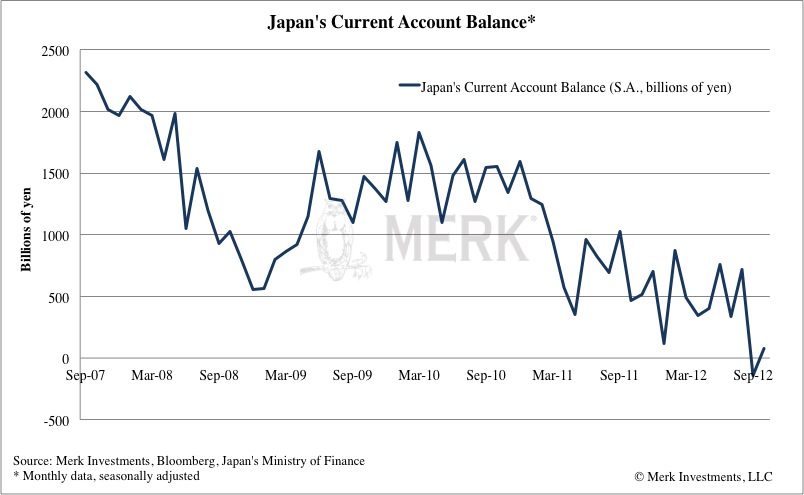
via: marketfunds
Now seems like the trend is breaking down, so it might be finally time to put those shorts against the Yen in.
" In the short-term, earthquakes disrupt economic growth; conventional wisdom suggests less growth leads to a weaker currency. However, economic growth and currencies do not correlate as highly as one might expect. Indeed, everything appears backwards in Japan, and there’s a reason: historically, Japan has enjoyed a current account surplus. As a result, Japan does not rely on inflows from abroad to finance its budget deficit. Despite conventional wisdom, note that when there’s a shock to the economy, consumers save more/spend less, a positive to a currency all else being equal (i.e., in the absence of a current account deficit). In contrast, countries like the United States, or New Zealand for that matter, have a current account deficit; in the absence of growth, foreigners are less inclined to invest in the country, potentially depriving the country of inflows needed to finance budget deficits and, in the process, putting downward pressure on the currency."
via: marketfunds
Now seems like the trend is breaking down, so it might be finally time to put those shorts against the Yen in.
Monday Links
- The Law Of Unbundling Leigh Drogen http://bit.ly/Vfml7c
- The Insourcing Boom - Charles Fishman - The Atlantic http://bit.ly/YG2ODr
- Barry Schwartz | Human Irrationality - What It Means to Be Rational | The European Magazine - The Debate Magazine http://bit.ly/YG2OmG
- Magazine Article http://bit.ly/VertIP
- Polar Ice Sheets Melt at Faster Pace http://bit.ly/VfmnMm
- Boston Review — Claude S. Fischer: Happiness Policy http://bit.ly/YjzYZc
- Seven Ways of Looking at the News That Mitt Romney's Dad Got Free McDonald's For Life http://bit.ly/YvQ4zb
Sunday, December 2, 2012
New Zealand Equity Markets
I don't know a lot about the New Zealand markets but this chart is interesting. Perhaps it has something to do with the Hobbit coming out? I mean, they do have it on their official currency. Then again, I'm sure someone will drop the line-'correlation doesn't imply causality' in my face, so lets just leave that one open.

Sunday night reads
- Daily chart Advent calendar: The second chart in our round-up looks at country's positions on the "Better-Life" index http://flpbd.it/jTswI
- Quebec company wants to put sap water on your table http://flpbd.it/1XRoH
- Quora: Powerful Crowd-Sourced Questions & Answershttp://davidmichaelangelosilva.wordpress.com/2012/11/28/quora-powerful-crowd-sourced-questions-answers/ …
- Hercules! Hercules! http://flpbd.it/QAT54
- "The story of Lost makes no sense." http://flpbd.it/Zi2kT
- Yet another finance Titan with a bad memory -- SAC chief Stevie Cohen http://flpbd.it/W3E7i
- Seven-day rainfall totals in ongoing “atmospheric river” event on U.S. West Coast. Big numbers. http://flpbd.it/H02Ki
- Mayy Haughey of Metafilter: Why I love Twitter and barely tolerate Facebook — http://flpbd.it/MGjUH
- 21 Ways You Should Take Advantage Of Your 20s | Thought Catalog http://bit.ly/PkU95L Kinkiness Index ? Fifty shades of data-visualisations: On sex and text | The Economist http://bit.ly/Yu6o3l
Saturday, December 1, 2012
Anti-fragility
If you haven't heard about it already, Taleb, the guy behind the Black Swan theory(or as they claim) is out with another book. Although I wasn't intending on buying the book initially, his Saturday essay (WSJ) was what finally convinced me. Then of course Felix Salmon came out with a review along with Matt Ridley , and I just couldn't wait for it to come in.
Although I haven't really read the entire thing(there's some deep stuff which deserves more than a quick read), here are some quick points :
- Taleb's attitude towards uncertainty can be summarized as - Randomness and uncertainty, you want to use them and not hide from them. You want to be the fire and wish for the wind. The mission is to domesticate, dominate, and conquer the opaque, the unique and the uncertain. But how?
- Anti-fragile is beyond resilient. The resilient merely resists the shocks and stays the same, the anti-fragile become stronger.
Taleb uses the example of the mythical creature Hydra, 'you cut the head of a Hydra and two grow out. That's anti-fragility right there.' - The anti-fragile loves randomness and uncertainty, and more crucially, loves errors. In fact, we are most better at what we do because of anti-fragility. Taleb says that - he'd rather be dumb and anti-fragile than smart and fragile.'
- His stance on risk is essentially the same as always and he goes on to mention that-"its far easier to figure out if something is fragile than to predict the occurrence of probability of it being fragile. Anything that has more upside that downside from random events is what is anti-fragile; the reverse is fragile."
- Just like spending a month in bed would lead to muscle atrophy, complex systems are weakened, even killed when deprived of stressors. This is the tragedy of modernity: as with neurotically overprotective parents, those trying to help are often hurting us the most.
- But some become anti-fragile at the risk of others, and such anti-fragility is hidden. While in the past, those who took the risk were liable for their actions, today the opposite is prominent. We are witnessing the rise of a new class of heroes who are members of I.A.N.D.(International Association of Name Droppers). They game the system and the citizens pay the price. (Moral Hazard perhaps?)
- Most of history has been written because of Black Swan events. Such events hijack our brains because they are un-explainable. We don't realize the role of these events because of an illusion of predictability. Because of our fears and our thirst for order, we tend to be harmed by such events rather than benefit from them.
- Man-made complex systems eliminate predictability and cause out-sized events, so the modern world may be increasing in technological knowledge, but paradoxically, it makes things a lot more predictable.
- We know a lot less about hundred-year floods than five-year floods, but every time we see a hundred-year flood, we throw it out and call it an outlier instead of learning from it.
- Mother nature is the best expert at rare events, and the best manager of Black Swans. It has succeeded to in getting here without Ivey League educated instructions. Anti-fragility is not just an antidote to Black Swans; understanding it makes us less intellectually fearful in accepting such events.
- The anti-fragile gains from errors in prediction. Things that gain from randomness should dominate the world, everything else should be gone. But somehow, we live in this world under the illusion that everything works under rules, an illusion labeled as 'lecturing birds on how to fly.'
- Taleb's hate for complexity is quite prominent as well, and he mentions that complications lead to multiplicative chains of unanticipated effects. Because of the opacity, an intervention leads to unforeseen consequences. He mentions that simplicity is difficult to implement; or like Steve Jobs would have said-"you have to work hard to get your thinking clean to make it simple."
- Heuristics are simplified rules of thumb that make things simple and easy to implement. But the main advantage is that the user knows that they are not perfect, and thus is susceptible to be fooled of their simplicity.
- The anti-fragile likes volatility and it also likes time. Why time? Because time is functionally similar to volatility. Its simply what a grandmother calls experience.
- Modernity has replaced ethics with legalese, and the law can be gamed with a good lawyer. Fragility is transferable, thus the first ethical rule is: If you see fraud and don't say fraud, you're a fraud.
- Anti-fragility is desirable in general, but not always, as there are cases when anti-fragility is costly. Further, its hard to consider that robustness is always desirable, or as Nietzche said-"one can die from being immortal. "
Although the book seems like a good mix of philosophy, history and finance so far, it does have its elements of humor. Taleb gives examples of how he's allergic to bankers and whenever there's one around, he can sense his irritation.
I'm sure this book is not for everyone, but for those who are looking for a Christmas downtime read, its definitely worth it.
Subscribe to:
Posts (Atom)