Open Strategist
Friday, November 23, 2012

Friday Links
- America's Two Earliest Startups Gave True Meaning To 'Perseverance' - Business Insider http://bit.ly/Y7jNht
- When the U.S. Asked Europe for Its Money Back - Bloomberg http://bit.ly/WFUNNZ
- All Hail the Sweet Potato http://bit.ly/UwT1us
- 7 More Habits of Highly Successful Bloggers http://bit.ly/WBaiqx
- BBC News - Economist magazine bets professor over China's future http://bit.ly/W2ZhJH
- HP's Autonomess should devour Marc Andreessen, too | Columns | Breakingviews http://bit.ly/UwT6ye
- Five economic trends to be thankful for http://bit.ly/UTjkt2
- BBC News - How technology opens the door for personalised pricing http://bit.ly/Y1QNrs
- Bill McBride Of Calculated Risk - Business Insider http://bit.ly/Y8Uzzk

Thursday, November 22, 2012


Thursday Links
- What Killed Michael Porter's Monitor Group? The One Force That Really Matters - Forbes http://bit.ly/Ug8TkV
- A Brief History of Chocolate | Arts & Culture | Smithsonian Magazine http://bit.ly/UrdT6p
- What Was on the Menu at the First Thanksgiving? | History & Archaeology | Smithsonian Magazine http://bit.ly/ti8kos
- Jack Welch: An Oral History - Businessweek http://bit.ly/WBWxrD
- Hank Greenberg Will Not Be Getting His $25 Billion Back This Week « http://bit.ly/WBWzzH
- Norway: The Last Haven? | Institutional Investor http://bit.ly/Ure3KS
- RIM CEO Confident About BlackBerry 10 and RIM's Future in Mobile Computing | Gadget Lab | Wired.com http://bit.ly/UQR1LH
- Nancy Folbre: Of Parents, Puppies and Robots http://bit.ly/WBWH2i
- Have the Courage to Be Direct - Anthony Tjan - Harvard Business Review http://bit.ly/THbAvt
Tuesday, November 20, 2012
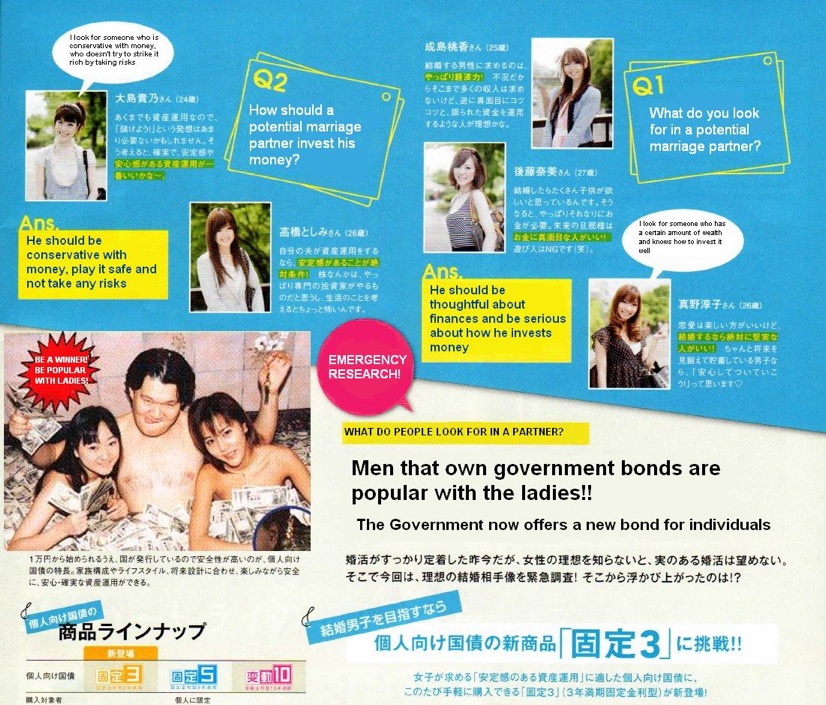
FW: Sex Sells JGBs
| This is one of those so bizarre you wonder if its real things: Apparently, according to this Bloomberg article – Women Prefer Men Holding State Bonds, Japan Ad Says — yes, it is:
"Men that own government bonds are popular with the ladies!" Yes, its a slow holiday week . . . |
A brief history of the Drachma

A national monetary system, based on silver, was established for the first time in 1828. This silver standard prevailed until 1832. In 1831, the currency’s convertibility into silver was suspended, and paper money was created to finance the budget deficits.
In May 1832, Otto’s monarchy succeeded democracy. Nine months later, in February 1833, bimetallism was introduced as the new monetary standard, and Otto’s Drachma was launched as the new legal tender. This was a silver currency. It weighed 4.029 grams of pure silver and was put into circulation in denominations of 0.5, 1 and 5 drachmas. In order to facilitate transactions, given the limited amount of drachmas in circulation,foreign currencies were allowed by law to circulate freely in the domestic money market.
However, the majority of these were tarnished, with a face value much higher than their
market value. As a result, Greek silver and gold coins quickly out-flowed since holders of foreign debased coins exchanged them for drachmas, which they then melted to obtain the precious metal. Thus, the drachma soon became an “ideal currency” that was used as “an accounting unit for foreign currencies and things of value”.
Growth in Greece was slow during those times due to lack of private investment capital. The first and second Independence loans contracted in Great Britain were greeted as a successful instigation of economic alliances with Western Europe, hence, an international recognition of the Struggle for Independence and of the fledgling Greek State.
However, these loans were not used for the purpose for which they had been intended, i.e. the furtherance and expansion of the Struggle for Independence. The first loan (472,000 pounds sterling) financed the civil wars of the years 1824-25, whereas the second loan (1.1 million pounds sterling) was squandered almost in its entirety abroad, either in England and America for the purchase of canons and the building of battleships – which never arrived in Greece.
Greece’s inability to repay the Independence loans destroyed the country’s reputation
as a borrower and deprived her of the European capital markets for a long period of time. The lack of money resources for the organization of the fledgling State’s domestic administration, the restoration of public safety, and the development of agriculture and commerce, created an urgent need for a new foreign loan.
However, this loan was also wasted in unproductive expenditures, such as the expenses of the Regency and the maintenance of a costly and unnecessary Bavarian army.
Bank of Greece
Bloomberg Echoes
Tuesday Links
- Who is McAfee? http://bit.ly/UOJYDp
- 'Bonkers' McAfee still on the run, with young woman | Herald Sun http://bit.ly/Wt62cy
- MarketPsych: Applying Behavior Finance: Traders Who Take Sex Hormones and the Impact of Investor Anger on Prices http://bit.ly/Ue7IST
- 1 | The 4 Secrets Behind Zynga’s Narcotically Addictive Games | Co.Design: business + innovation + design http://bit.ly/U8dwgX
- This is your brain on coupons http://bit.ly/WpLMsh
- McSweeney’s Internet Tendency: Welcome to Belinda’s Private Equity Immersion Daycare. http://bit.ly/Wt69F1
- How Music at the Office Affects Your Work Life - Businessweek http://bit.ly/Ue7POj
- Why We Like Crisp, New Dollar Bills - Businessweek http://bit.ly/Ue7QC0
- The Plot to Destroy America's Beer - Businessweek http://bit.ly/Sd5Sn0
Monday, November 19, 2012
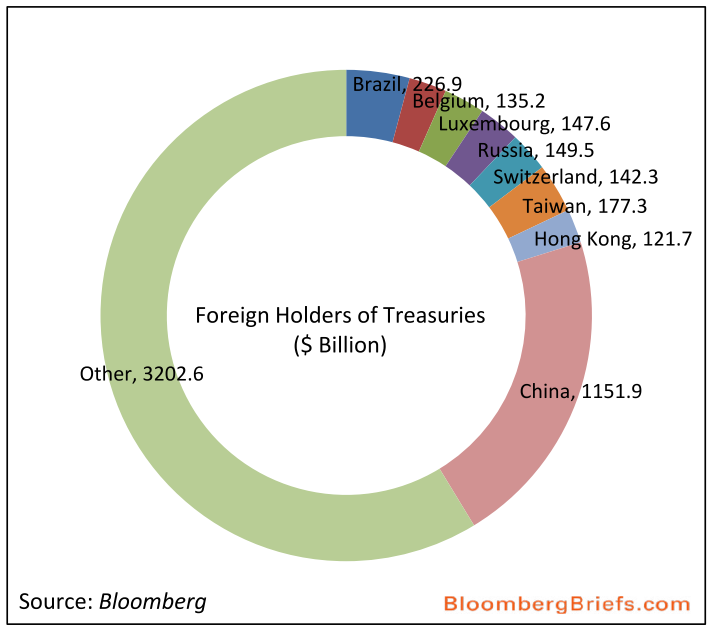
FW: Foreign Holders of US Treasuries
| Treasuries' Foreign Buying Doubles China's $123 Billion Cut |