Showing posts with label Management. Show all posts

Sunday, February 14, 2016

Revisiting my media consumption habits

Top Podcasts:
Serial (Season 2 isn't the best, but still an incredible master class in investigative journalism)
Tim Ferris show(great interviews in general)
Planet Money(short and crips - always)

Some that listen to here and there:
Reply All
Startup
Radiolab
99% invisible
Energy Gang
Criminal
Ted Radio Hour

Stuff that I've completely cut out:
Live markets news/WSJ/Bloomberg Live
Stuff partially cut out:
Economist(I read it cover to cover for years, but still a little negative; still read the technology/science/International segments)
FT Alphaville(too addictive to stop reading)

Value investing:
valueinvestingworld.com
Slack access to Manual of ideas
valuewalk.com
hurricanecapital
punchcardblog

Sunday, March 2, 2014

Be the Distruptor

"there has to be a technological core....not per say, but improvement can be brought through sophistication - that has to exist in order for disruption to occur."

H/T : VIW


Saturday, February 22, 2014

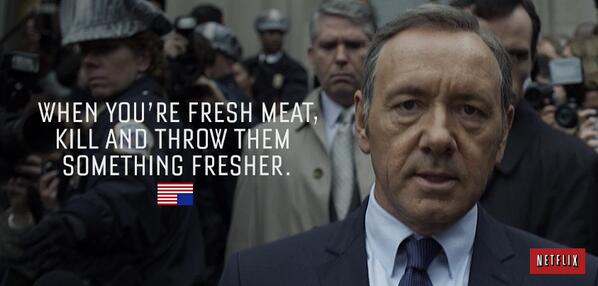
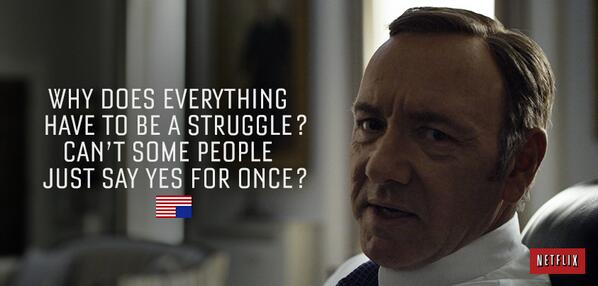
Top Quotes / Lessons from House of Cards


  • "One heartbeat from the President and not a single vote cast in my name - democracy is so over-rated"
  • "There is no sacred ground for the conquered"
  • "I won't leave one of my own bleeding on the field"
  • "Mr. Vice President, what you're asking for is just shy of treason." "Just shy. Which is politics."
  • "I've always loathed the necessity of sleep, like death it puts even the most powerful men on their backs"
  • “I don’t know whether to be proud or terrified. Perhaps both.”
  • "If you don't like you the table is set - turn it over"
  • "He's in the darkness now and I'm the only beacon of light. Now we gently guide him toward the rocks"
  • "There is nothing more disgraceful than running from a battle"
  • "Should have thought of this before. Appeal to the heart, not the brain"
  • "Not everyone can be on the right side of history"
  • "We'll put this behind us. Just like we've always done"
  • "I don’t know whether to be proud or terrified. Perhaps both"
  • "You’re connecting dots that don’t exist"


Except for children.
here are two types of vice presidents, doormats and matadors.
From a lion’s den to a pack of wolves.
Embedded image permalink

Monday, February 10, 2014

Review - The Firm: The story of Mckinsey

I finished the story of McKinsey by Duff McDonald fairly recently. I have to say, it was hard to put down - just like Duff's previous book I read (biography of Jamie Dimon). Here are some things I learned / found interesting:

  • The original consultants at McKinsey were 'management engineers' not high flying MBA's - this might highlight the fact that at one point in time, process improvement by engineers was the key function of a consultant
  • By definition, you improvise in battle, and he who improvises best wins -  Although he was one of the firm’s first champions of a strategy practice, Ohmae became famous for his later repudiation of the idea of formal corporate strategy—arguing a variant of Prussian general Helmuth von Moltke’s dictum that all strategic plans become nullified on first contact with the enemy.
  • Perhaps searching for problems that fit your toolbox isn't the best idea; instead you should search for problems that need solving -  We need a conceptual supernova, a direct response to BCG’s matrix. That was exactly what we didn’t need. We want to help our clients solve the problems they have, not the problems we know how to solve. We don’t want to be a solution in search of a problem, and that’s what the four-box matrix was. That’s what the experience curve was. Sometimes they worked. And sometimes they didn’t.
  • McK has both generalists and specialists - In arguing that the firm needed both “snowball makers” (specialists) and “snowball throwers” (generalist rainmakers), he said, “Every McKinsey consultant needs to be a generalist, but it’s not necessarily a handicap to know what you’re talking about.” He later added, “Would you want your brain surgery done by a general practitioner just in what McKinsey knew but in who at McKinsey knew these subject areas. An unstated understanding emerged that if you were a logistics expert in, say, the retail sector and you were called by a partner you had never met who mainly did work with pharmaceutical companies, you would nevertheless return the call. That reputation for contributing was your asset in the firm.
  • McK ruthlessly focuses on structured thinking, something that not everyone appreciated - Peters and Waterman were suggesting that the secrets to success were not necessarily quantifiable, that they might be impervious to rigorous analysis. They talked of focusing on the customer and on the employee, not just on org charts and spreadsheets.Whereas before, Peters and Waterman had been talking about a range of topics—from people to involvement, trust, listening, and wandering—with this new insight, the ideas now slid off the tongue: skills, staff, style, systems, structure, shared values, and strategy. (And propagating a tradition that has become accepted in most consulting circles but definitely within McKinsey: Every idea needs an odd number of bullet points to be explained.)
  • Tom Peters left the firm with a not so amicable relationship - Peters still has a testy relationship with the firm. “McKinsey has a stratospheric belief in itself,” he has said. “If intellectual arrogance had not yet been invented,” he continued, “it would have been invented for that crew. But let me tell you this: I am sixty-seven years old, and I have had the luck of God smile on me, but I am still scared shitless of McKinsey people.”29 The firm even found a way to needle him in its privately published internal history. “There’s a caption under a picture of me that made me laugh hysterically,” he said. “I am described as undisciplined but brilliant. I have no problem with ‘brilliant,’ but ‘undisciplined’ made me turn purple in the face. You don’t write sixteen books, give three thousand speeches, and work eighteen hours a day for thirty years and be undisciplined. It’s typical fucking McKinsey. Why do you need to say things like that?”(A McKinsey partner responded: “He just said it. Three thousand speeches and sixteen books is exactly what we meant. He’s undisciplined. He should have focused on two clients and one book.”)
  • People at the firm learn from the partners, clients are good enough - Not surprisingly, the consultants exhibited a renewed confidence that occasionally veered right into arrogance. “There are only three great institutions left in the world: The Marines, The Catholic Church, and McKinsey,” one partner told BusinessWeek in 1986.48 London office manager Peter Foy suggested, “There is no institution on the planet that has more integrity than McKinsey and company.” In a Forbes article, a McKinsey partner summed up the self-image neatly: “We don’t learn from clients. Their standards aren’t high enough. We learn from other McKinsey partners.”
  • Few clients are going to hire McKinsey and then say the consultants weren’t worth it - In a sense, the firm is a spiritual relative of “La Belle” Otero, a courtesan living in Paris in the early part of the twentieth century who was once considered the most sought-after woman in the world. Carolina Otero was very selective about her clientele and charged outrageous fees that reportedly topped $1 million in 2012 dollars. Her customers included Prince Albert I of Monaco and the king of Serbia, and it was widely argued that everybody who had the means had to have her at least once. And once you’d done that, what could you say? Once you’d paid a million francs for a roll in the hay, you weren’t about to admit it wasn’t worth the price paid.
  • McKinsey’s work for General Motors in the early 1980s showed quite clearly that consultants can sometimes do far more harm than good to a company, even if it’s one of the most important clients they might ever have. At the time, General Motors—the Titanic of American business—was being pummeled by Japanese carmakers like Toyota. Chairman Roger Smith decided in 1984 to embark on the most massive reorganization of a company in American history.
  • McKinsey interviewed the top sixty-five executives in the company and eight hundred employees, asking them what organizational problems they saw. With their poll results in hand, the consultants proposed a new structure. Instead of organizing the company by brand—Chevy, Cadillac, Buick, et cetera—the consultants said it should be organized by type of car—large, small, truck. This was a basic McKinsey maneuver—don’t organize around this, organize around that—and it had worked in the past. The consultants had successfully helped AT&T organize around its markets as opposed to its technologies, for example. But it was not the right prescription for GM.
    “Only later did people begin to realize that it wasn’t the fact that the Japanese had a compliant low-paid workforce that got up every day and sang the Toyota hymn.t was that they built cars with fewer parts, fewer defects, continuous improvement processes, and took man-hours out of making cars without compromising productivity. I’m 100 percent sure McKinsey had no clue about these revelations.”
  • Instead, McKinsey just moved people around, and this had the effect of destroying institutional knowledge and the informal networks of people who knew how to get things done inside the massive company. “They were flying perpendicular to where they should have been,” said Keller. “It was the thousands of little things Toyota did well that mattered, not the organizational design of General Motors.”
  • The Prussians beat the French in 1871, but not because they had inspired leadership. 
  • They won because their system was based on rules, orders, and norms that allowed their army to run efficiently and without the need for heroes. Likewise, Industrial Prussianism skips the heroes and focuses on efficiency and frugality, with training and accountability. The only point of strategic planning is to think through all contingencies in advance so as to make fewer tactical execution errors; he who makes the fewest and has the best-organized and best-trained troops wins. The companies that survive, like the best armies, can recover from unexpected blows of fate and competitor breakthroughs.
  • Even today, the best consultants are ex-engineers, not perfectly designed social operators with a Harvard MBA. Engineering teaches you to define your solution space, determine the relevant levers you can pull or push, and then find your solution. Strategize all you want, but if your processes aren’t well oiled, you’re a goner.
  • McKinsey can also be hired when one executive needs “disinterested” support for an idea that might just also result in the removal of an internal rival. Lee Iacocca wrote in his autobiography that when Henry Ford wanted Iacocca out of the firm, he hired McKinsey to recommend a new organizational structure. Iacocca went to Chrysler, where he used Bain & Company instead of McKinsey.
  • Gupta stood for one more thing: the end of the firm’s ambivalence about making money
    Gupta was clearly the man to put a halt to what he considered to be money-wasting research. In his twenty-one years at the firm, he had contributed a sum total of zero articles to McKinsey’s knowledge-management system. “He may have said he respected our knowledge building,” continued the partner, “but actions speak louder than words.”
  • You can't beat culture - McKinsey had to make other adjustments in China. Throwing young Harvard MBAs into the fire by making them present to CEOs so soon after being hired wasn’t prudent in a hierarchical society that values age and experience over youthful promise. This wasn’t a new issue for the firm: In the 1980s, when he was managing director, Ron Daniel had one meeting with the parents of a prospective Japanese recruit in which he had to reassure them that their young son was not being sold into some sort of modern slavery. “Asians venerate age,” he explained. “We tend not to.”
  • “Never underestimate the lemming-express effect that obtains among students at ‘top’ business schools and colleagues,” wrote author Walter Kiechel. “You compete to get into the most prestigious college. Then you compete to get into the top-ranked business school. After you’ve learned and displayed so much independence of mind, what’s left but to compete to be hired by the employer all your peers were clamoring to join?
    ON ENRON:

    One: The firm endorsed Enron’s asset-light strategy. In a 1997 edition of the Quarterly, consultants wrote that “Enron was not distinctive at building and operating power stations, but it didn’t matter; these skills could be contracted out. Rather, it was good at negotiating contracts, financing, and government guarantee—precisely the skills that distinguished successful players.”
  • Two: The firm endorsed Enron’s “loose-tight” culture. Or, more precisely, McKinsey endorsed Enron’s use of a term that came straight out of In Search of Excellence. In a 1998 Quarterly, the consultants peripherally praised Enron’s culture of “[allowing executives] to make decisions without seeking constant approval from above; a clear link between daily activities and business results (even if not a P&L); something new to work on as often as possible.”
  • Three: The firm endorsed Enron’s use of off–balance-sheet financing. In that same 1997 Quarterly, the consultants wrote that “the deployment of off–balance-sheet funds using institutional investment money fostered [Enron’s] securitization skills and granted it access to capital at below the hurdle rates of major oil companies.”
  • On Jeff Skilling: Jeff Skilling’s presentation on how he had turned an energy company into a financial company. “All anyone was talking about was how dazzling Skilling was,” said the ex-partner. “The analytics he showed! Everyone was having little orgasms in the elevator! The whole episode raised three very important questions. First, did McKinsey stray from its core values by effectively hyping Enron during the fraudulent rise? Second, was the firm liable for any of Enron’s misdeeds? And third, would other clients care? The short answers: Yes, No, and No.
  • The firm imposed up-or-out on everyone - In 2007 the firm advised Walmart that the cost of an “associate” with seven years of tenure was almost 55 percent more than the cost of one with just a single year of tenure, but there was no difference in their productivity. Beyond the obvious offensiveness of suggesting Walmart lay off its experienced and loyal staff in favor of cheap new labor, this was up-or-out all over again. McKinsey could push its system even in a place like Walmart.
  • Charlie Munger, Warren Buffett’s longtime partner at Berkshire Hathaway, wrote in his book Poor Charlie’s Almanack: The Wit and Wisdom of Charles T. Munger that he had never met a corporate leader who’d actually read a consulting report. 
  • Pin executives down, and they will surely be able to tell you about the most important decisions of their career. In a large organization, though—the kind for which McKinsey works—the value of most decisions doesn’t necessarily reside in the actual choice made; it resides in the very fact that the choice is being made in the first place. Leadership is about getting people to follow you, but before they can do that you need to choose the direction in which you’re heading. There will always be demand for such a service, and that’s precisely what McKinsey provides.
All in all, an excellent read and highly recommended to anyone looking for a background on the most powerful consulting firm in the world. 

Saturday, August 3, 2013

A quote from popular delusions and manias

"In reading the history of nations, we find that, like individuals, they have their whims and their peculiarities; their seasons of excitement and recklessness, when they care not what they do. We find that whole communities suddenly fix their minds upon one object, and go mad in its pursuit; that millions of people become simultaneously impressed with one delusion, and run after it, till their attention is caught by some new folly more captivating than the first. We see one nation suddenly seized, from its highest to its lowest members, with a fierce desire of military glory; another as suddenly becoming crazed upon a religious scruple; and neither of them recovering its senses until it has shed rivers of blood and sowed a harvest of groans and tears, to be reaped by its posterity."

via: gutenberg

Thursday, February 7, 2013

Out of the office

I'll be out of the country travelling to India for a wedding for the next two weeks so excuse my shortage of postings, but here's some life lessons to keep you going:
  1. Continue to read and learn and always be genuinely interested in people. You'll be surprised how fascinating life is when you exchange ideas with others. 
  2. Have the courage to pursue what you want. You've probably heard this one before and probably have thought of it at one point at the other, but its worth re-enforcing  The most common regret people have about their careers is about not taking 'that chance.'
  3. Nothing in the life is useless. That being said, doing menial tasks everyday isn't going to teach you a lot, but if you add some learning to it via some form of media(pop you're headphones in and listen to a podcast or something) you might just become a better person.
    And if you see others pursuing things that you might think are useless then remember what Abraham Flexner said, "you merely have to find the catalyst or be the catalyst to the useless to become the useful." 
  4. Find an alternative purpose - The most successful and happy people I've met in life are the ones who weren't obsessed with their careers or anything for that matter, but were the ones who always found other interests in hobbies or their family lives to accentuate their primary passions.
    That being said, here's something interesting on happiness:
    "It is[happiness], in large part, about giving something to the world that makes the world a better place. That could be goods or services or your time or something else. Who knows? But happiness is not merely the pursuit of personal happiness, but providing something to your surroundings that gives other people reason to value your contribution." - Cullen Roche
  5. Friendship is the rum of life, pursue it. It's also a lot different than family relationships because friends are not held by obligations but by shared interests.
  6. Listen to your parents but take their advice with a grain of salt. Parents want what's good for you, but not what's best for you - they don't understand that sometimes the path to what's best for you is through pain,suffering and self-actualization. 
  7. Write more - you'll be surprised how much more you remember from writing than just by reading or listening. 
  8. Keep Fit - Not only is this good for you're body and will keep your healthcare costs down when you get old(yes, we all get there someday), but it will also be essential to become a leader. Think of you're body as a business - if people observe you and see you as someone who can't even execute their life in order, why would they trust you with a company?
  9. Always be anti-fragile
  10. The world runs on the premise of social proof. Kitty Genovese was murdered in public with 38 witnesses and no one helped her. Society is just like that where people see others and act / don't act based on what others think. Don't succumb to mass-hysteria and make decisions that are independently thought out by you. 

Wednesday, December 19, 2012

In pursuit of uselessness


Last time I did a post on the philantrophy of Warren Buffet. In his conversations  Buffet mentioned a philanthropist that no one else knew about and that was “Abraham Flexner”. I did some research on Flexner and learned that he truly did change the face of medicine in America, but Flexner also brought to light a philosophy on education reform that is very relevant today.

Flexner believed that people detach themselves from the realities of everyday life to devote themselves to engagement in other things they prefer, perhaps to escape the tedium of the days. The world today and even before that has been in a sorry state, and people tend to ignore the factors which impact them most. There is much wrong in this world already, and unless there is a conscious effort to change that, the world will continue to be in its sorry state. Whether there will be sufficient opportunities to lead a full life, in other words, whether we will find purpose in what we deem useful is a more philosophical question, for our definition of what’s useful might have become too narrow.

Flexner once posed a question to George Eastman –“Who is the most useful worker in the field of science?” and the reply came back as “Marconi”. But the truth is that Marconi was not the inventor, but merely the aggregator of the findings of others before him. Maxwell and Hertz had done most of the work well before Marconi, and neither were they concerned with the utility nor the practical objectives of their developments.
The entire history of science is filled with people who did what the did merely to satisfy their curiosity. ‘Curiosity’ was the only thing the were concerned with and they satisfied their spiritual selves with such undertakings.

Institutions of education and learning should be devoted to cultivation of curiosity rather than immediate application, and by doing this, they are more likely to contribute to human welfare.

But Flexner also noted that - “It is merely the folly of man and not the intention of scientists that is responsible for the destructive use of agents employed in modern warfare”. Take machines for example, which originally started with the invention of the printing press and for the greater good of mankind, but soon turned into unmanned drones designed strictly to spy and kill.


Alfred Noble, whose name is attached to establishment of the Nobel Prizes, made his wealth by producing commercial dynamite, which found its use in mining, railroad tunnel establishment, but also of course to the abuse of politicians for warfare.

The Wright brothers built the airplane with the dream and obsession to fly like the birds, but politicians with their corrupt minds again found its purpose in warfare.

Perhaps it is also true that blaming Quant’s for inventing derivatives is also a misdirected exercise. The greed of humanity has existed since its existence; only the tools have changed.

Marc Anderson recently at the Deal breaker Conference recently said that people who majored in English will end up working at shoe stores, but such statements discount the capacity of humans to apply and borrow knowledge from different spectrum's and apply it somewhere else(I emphasized this in my post on Andrew Carnegie).

No educational institution can possibly direct the channels in which someone should work. Knowledge can only be acquired if one makes an effort to acquire it; no one can force learning on anyone else. Thus such eccentric but curious pursuits, perhaps aren't wasteful at all.

But this is not to criticize institutions who make an effort to integrate applied learning(STEM sector degrees, or business school perhaps?), but only to state that the useless is a feeder to the useful. Marconi was successful because he picked the brains of right men. This also points to the fact that any scientific discovery is rarely attributed to a sole inventor, the most critical example here is Tesla(and if you don’t know who that is, please do this world a favor and read this)

Even in the pursuit of the practical an enormous amount of useless activity goes on. The mere fact that they bring satisfaction to an individual is all the justification that is needed. Flexner also mentioned that such motivation runs deeper than any other since it has to deal with the dissimilarities of humanity:
 “Does humanity want symphonies and paintings and profound scientific truth, or does it want Christian symphonies, Christian paintings, Christian science, or Jewish symphonies, Jewish paintings, Jewish science, or Mohammedan or Egyptian or Japanese or Chinese or American or German or Russian or Communist or  conservative contributions…”

A Harvard professor was once offered a stipend to move to Princeton; on the offer he asked-“What are my duties?” To which the Flexner replied -“There are no duties – only opportunities.”
Perhaps if we all start seeing the world as a land of opportunities, we can also find and pick the brains of others who have been busy doing useless things. Maybe innovation really is just finding the catalyst or becoming the catalyst to whatever useless stuff there is already out there.

Socrates once said that –“An unexplained life isn’t really worth living for”. I hope that you continue to leave nothing unexplained and set only one goal for yourself for next year – and that is to continue a pursuit for useless knowledge that will have consequences in the future that won’t be so useless after all.

Read More:

Monday, November 19, 2012

Why I don't read fiction

I spend a lot of time on the subway, but actually kind of like it because it forces me to open and close my work hours with some reading. There’s lots of people who take transit actually. Usually in the mornings I see people talk to their friends, catch up on some shut eye, listen to music and of course I see women fixing their makeup(I’ll refrain from making judgments on whether this is appropriate or not). I’m usually one of the few who has a my tablet whipped out and as always, reading through my never ending stack of journalism and research on investing, business, economics, science, politics, profiles etc.

People often ask me why I don’t read fiction? Now that being said, I used to love fiction as a child, and my parents used to buy me lots of books and read to me as well; my favorite fiction book is still ’20,000 leagues under the sea’, but when people ask me that question, I usually flip the question back at them, and typically find the answer to be the same-‘to get away from reality and enter a world where anything could happen.’

I’ve always found it to be the case that fiction readers are the ones who tend to be disappointed with their lives and try to get away to a world they wish they could have been part of. I never read fiction because I always feel that I’m not learning anything, but perhaps that’s not my true motivation. Maybe I’ll never find out the true answer to that question, but it’s definitely something to think about.

 Why are you reading fiction?

Sunday, September 9, 2012

What is your business objective?

But the search for one business objective or a magical formula is likely to be as unproductive as the search for the philosophers stone. And to label the objective as 'make profit' tends to undermine the future. To balance the needs of a business, you need a variety of goals and targets and that by definition makes it a bundle of objectives. So what should these objectives be?
There is only one answer to that, and that is, objectives are needed in every business area where performance is vital to the survival and prosperity of the business.

Regardless of what business you're in, what economic conditions are like, and whatever the business size, its precisely this fundamental theorem that is critical and everything else must be discarded.
Plan well.


Sunday, August 19, 2012

A poker player on Return on Equity

Most people here have probably heard of David Einhorn , the infamous hedge fund manager who shorted Lehman Brothers. But to most other people who don’t know what a hedge fund is, I’d say that he’s an investor. Everyone knows what an investor is; people who make money buying stocks are investors, and people who lose money while picking stocks are called speculators (or is it the other way around?)

But not only is Einhorn known for his value investing skills, but also for his poker skills, which makes his story very interesting. But are investing and poker similar? Is gambling and investing the same thing? Is winning at investing and gambling purely based on luck? “Not really” says Einhorn, “but sample size matters. Over time, and over thousands of hands against a variety of players, skills win out”.

But let’s get to Einhorn’s opinion on Return on Equity (ROE) today. According to him, there are essentially two types of businesses:
Capital intensive ones and non-capital intensive ones. A capital intensive business is one which requires capital to grow, for example, to build another plant, a manufacturing facility of some sort etc.

Non-capital intensive businesses are those that do not require capital or physical resources to grow. These businesses grow based on intellectual capital and human capital. Examples would be, pharmaceutical companies (which rely on their patents to generate revenue), software firms (which rely on the software they built to generate revenue) and consulting firms (which rely on their people to generate revenue). Most other companies that sell services would qualify as well here.

Einhorn points out that it is irrelevant to worry about ROE for non-capital intensive businesses. If a consulting firm had twice as many desks and office locations, it wouldn’t really mean that per consultant revenue would double, especially considering they travel to client sites to advise them; it would be redundant to add such resources.
It follows from this that the price-to-book value ratio is irrelevant for such companies because they derive their value from brand equity, intellectual and human capital which is not reflected on the balance sheet.

But for these companies, the question becomes ‘what to do with the spare cash?’
They could return the cash generated to the shareholders or do something a lot worse, enter capital-intensive businesses.
Take for example, the infamous ‘investment bank’. Investments banking advisory services are wonderful non-capital intensive businesses. Fee is paid to these banks for their advice and the only important asset is the people who go up and down the elevator.
But once they start lending money to investors, they become a little capital intensive. Then they enter into PE and other illiquid areas and become even more capital intensive. And before you know it, they turn into capital intensive businesses. And the irony is that everyone else is coming to these banks for advice on how to create more shareholder value while these banks themselves dilute their own ROE with capital-intensive activity.

But this doesn’t mean non-capital intensive businesses are always excellent ‘BUYS’. Their high returns attract new entrants and competition ends up driving down the ROE.

Investing based on ROE can be tricky, but David’s point above is definitely worth considering. So what are you investing in, capital intensive or non-capital intensive businesses?

Read More: Einhorn's speech